Kirk Maynard Gull
Jonathan Livingston SeagullKirk Maynard Gull is a young gull whose first appearance overturns the assumption that a damaged wing defines what he can do. Dragging his left wing and unable to move it, he reaches Jonathan Livingston Seagull’s students and asks to fly; after Jonathan tells him that he is free, Kirk rises effortlessly into the night. His sudden flight becomes the first vivid proof, witnessed by the waking Flock, that the limits it treats as fixed may be challenged through a different understanding of the self.
Identity and Introduction
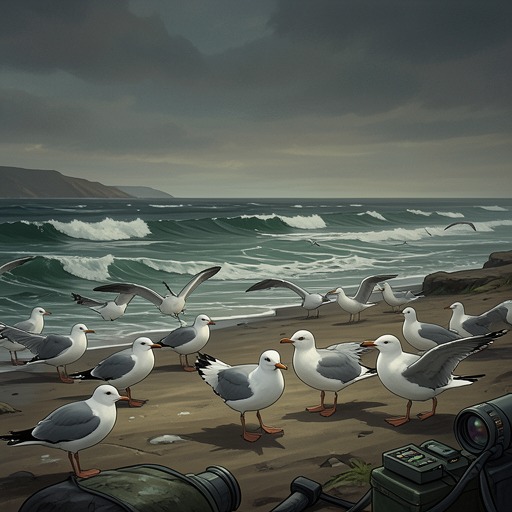
Kirk appears in the aftermath of the Outcasts’ return to the Flock’s beach. Jonathan and his students have been practicing openly, though the Elder’s order is that the Outcasts be ignored and that any gull who speaks to or even looks at them will become an Outcast too. The students’ circle nevertheless draws listeners. After Terrence Lowell Gull crosses the line to ask for instruction and is condemned as an Outcast, Kirk arrives the following night from the Flock.
He is introduced through his physical difficulty: he wobbles across the sand, drags his left wing, and collapses at Jonathan’s feet. He speaks very quietly, in the manner of someone near death, and says that he wants to fly more than anything in the world. The scene makes his desire unmistakable while presenting his injured wing as an immediate obstacle, not a metaphor that can simply be ignored. He believes he cannot move it, and asks for help at the moment when his body seems to deny the very possibility he seeks.
The First Flight
Jonathan does not answer Kirk’s plea by treating the wing as something that must first be repaired. He invites him to climb away from the ground and begin. Kirk objects that Jonathan has not understood: his wing cannot move. Jonathan responds that Kirk has the freedom to be his true self here and now, and calls this freedom the Law of the Great Gull, the Law that Is. When Kirk asks whether Jonathan is saying he can fly, Jonathan answers that he is free.
The change is immediate. Kirk spreads his wings effortlessly and lifts into the dark night air. The narration presents no gradual recovery or extended lesson between Jonathan’s words and Kirk’s ascent; the turn from collapse to flight is as simple and quick as the story can make it. From five hundred feet above the ground, Kirk cries out that he can fly, loud enough to wake the Flock. The exclamation is not merely a private discovery: he makes the transformation audible to the community that has excluded Jonathan’s teaching.
The Flock and Jonathan’s Teaching
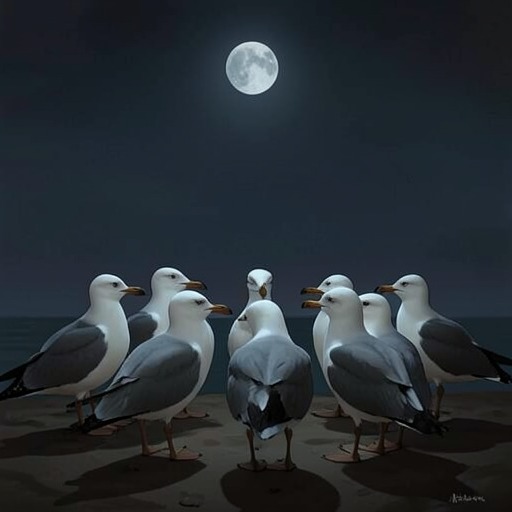
By sunrise, nearly a thousand birds are standing outside the students’ circle, now willing to be seen as they listen to Jonathan. Kirk’s flight has helped draw them there, giving the teaching a concrete, public instance. Jonathan speaks of a gull’s right to fly and of freedom as the nature of being; what stands against that freedom, he says, whether ritual, superstition, or limitation, must be set aside.
The crowd tests the scope of that principle by asking whether even the Law of the Flock should be set aside. Jonathan answers that the only true law is the one that leads to freedom. When another listener suggests that Jonathan’s students are exceptional, he points to Fletcher Lynd Seagull, Lowell, Charles-Roland, and Judy Lee, insisting that they are no more specially gifted or divine than anyone else: they have begun to understand what they are and to practice it. Kirk’s ascent belongs to this argument. It shows a gull whom the scene first defines by an apparently immovable wing rising into the air, making the difference between presumed incapacity and practiced freedom visible to the watching birds.
Change and Significance
Kirk’s transformation is compressed into a few gestures and words: he arrives dragging his wing, states that he cannot move it, hears Jonathan name his freedom, opens his wings, and flies. That concentrated sequence gives his encounter a distinct role within the broader teaching. Where Jonathan’s ideas could seem abstract or reserved for unusually skilled fliers, Kirk’s visible change puts them before the Flock as an immediate possibility. The story does not describe a later course of training for him, so the evidence of his change rests on that first effortless lift and the cry with which he announces it.
His flight also marks a shift in the setting around the students. Until then, the Flock’s rule has made contact with the Outcasts a punishable breach, and even curious gulls have gathered in secret, listening at night and disappearing before daybreak. In the morning after Kirk rises, the listeners no longer conceal themselves. The account does not state that his flight alone causes the crowd’s change, but it places the two developments together: Kirk’s public proof is followed by a visible gathering of nearly a thousand gulls, ready to hear a teaching that challenges the boundary imposed by the Flock.